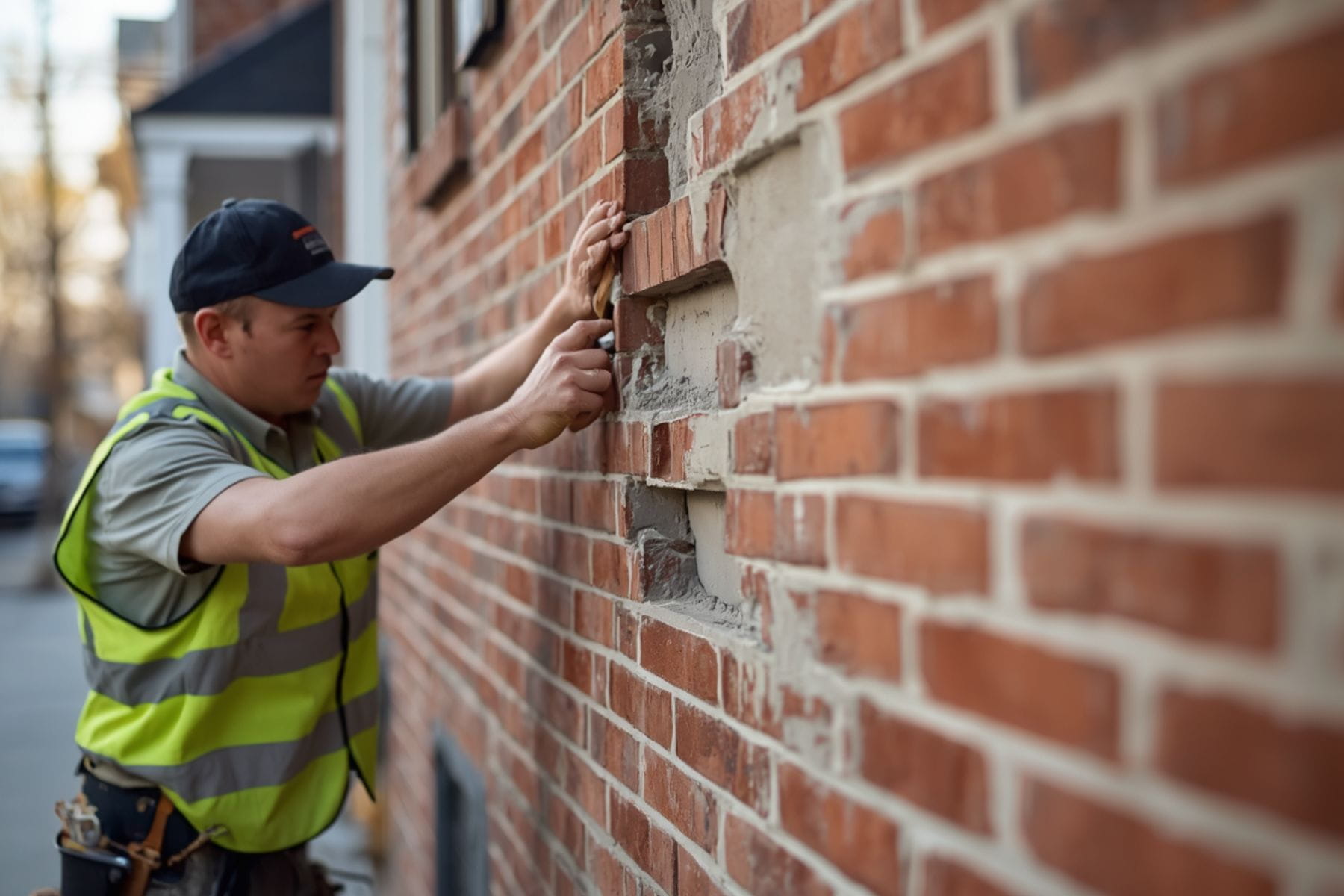
Staten Island Brick Repair
Expert Repointing, Tuck-Pointing, and Masonry Restoration by a Licensed Local Crew — No Subcontractors, Ever
What Is Brick Repair — And Why Do Staten Island Homes Need It?
Brick is one of the most durable building materials ever developed, but it is not immune to the forces of nature — and on Staten Island, those forces are relentless. Every year from November through March, our borough experiences the northeastern freeze-thaw cycle that slowly destroys masonry that has been left without proper maintenance. Water seeps into microscopic cracks in mortar joints. Temperatures drop below freezing, and that trapped moisture expands roughly nine percent as it turns to ice. The expansion force cracks mortar, pushes brick faces apart, and spalls the outer layer right off the brick surface. When temperatures rise, the ice melts, water flows deeper into the newly widened gaps — and the cycle repeats with the next cold snap.
After ten or twenty years of this, a wall that looked solid begins to show its age: recessed mortar joints, crumbling grout lines, powdery white efflorescence, and individual bricks with their faces blown clean off. This is not cosmetic damage. Water infiltrating your exterior masonry wall moves toward your framing, your insulation, and eventually your interior finish surfaces. What begins as a mortar joint repair becomes a wall replacement — and sometimes far worse.
Brick repair is the professional process of diagnosing and correcting this deterioration. Depending on what we find, the repair might involve repointing (removing failed mortar and packing fresh mortar into joints), tuckpointing (a finish technique that creates a crisp, dual-color joint profile), or full brick unit replacement where individual units have cracked, spalled, or shifted beyond rescue. In every case, the goal is the same: restore the watertight integrity of the masonry system so water has no pathway through the wall.
Island Built Masonry is a Staten Island masonry contractor that handles brick repair exclusively with our own trained, licensed crew. We never subcontract labor. That policy is not a marketing talking point — it is how we guarantee consistent workmanship on every single job.
Our Brick Repair Process
We do not show up with a caulking gun and call the job done. Every brick repair project Island Built Masonry takes on follows a deliberate, step-by-step process that produces work built to last.
Step 1: Free On-Site Assessment Before any quote is written, one of our crew leaders walks the property with you. Whether you are in Great Kills, Tottenville, Eltingville, or St. George, we make the trip and we bring our eyes and experience. We examine the mortar joints across the entire affected area, probe for soft spots and voids, look for patterns of cracking that indicate structural movement rather than simple aging, and check for moisture damage behind the wall where accessible. This assessment determines the true scope of work — not a guess from a phone call.
Step 2: Written Estimate with Clear Scope After the assessment, we provide a written estimate that describes the work in plain language. Because Island Built Masonry operates on a quote-based model, you will know the full scope before a single tool comes out. No surprise add-ons. No hidden line items.
Step 3: Mortar Removal to Proper Depth Shallow raking is one of the most common failures in amateur brick repair. Skimming a thin layer of new mortar over old deteriorated mortar gives a repair that fails within one or two seasons — the old failing mortar continues to crack underneath the new surface. We remove deteriorated mortar to a minimum depth of three-quarters of an inch, using angle grinders with masonry blades and hand chisels for detail work around arches and decorative coursework. The face of adjacent brick units is protected throughout this process.
Step 4: Mortar Specification and Matching Mortar science matters more than most homeowners realize. Modern premixed mortars are often too hard for older, softer brick construction — using a high-strength Type M mortar on a pre-war brick wall accelerates spalling by making the mortar stiffer than the brick, so freeze-thaw stresses crush the brick face rather than cracking the joint as designed. We assess your existing construction and specify the correct mortar type: typically Type S or a Type N blend for above-grade exterior walls, with color additives selected to match the existing weathered joint color as closely as possible.
Step 5: Repointing, Tooling, and Unit Replacement Fresh mortar is packed into cleaned joints in layers, compacted thoroughly, and tooled to match the original joint profile — concave, flush, struck, or weathered depending on the building’s original style. Where individual brick units have failed, we source matching brick from masonry suppliers and set replacement units in fresh mortar beds with proper bed and head joints. We do not use patch mortar to fill spalled brick faces — that is a temporary fix that fails visibly and quickly.
Step 6: Efflorescence Treatment and Final Cleanup After mortar has cured, any efflorescence on the surrounding brick surface is treated and removed. We clean up all debris, dispose of removed mortar, and do a full walkthrough with you before calling the job complete. Our job is not done until you are satisfied.
Common Brick Problems We Repair on Staten Island
Spalling Brick Units The freeze-thaw cycle is the primary culprit. Water trapped behind the outer face of a brick expands during a freeze and breaks the outer wythe off with tremendous force. Spalled brick cannot be patched — the exposed inner body of the brick is porous and will absorb far more moisture than an intact face. Spalled units must be removed and replaced with matching brick.
Deteriorated Mortar Joints Mortar has a finite lifespan, typically 20 to 30 years in northeastern climates with hard winters. As mortar ages, it becomes porous, begins to recede from the brick faces, and eventually cracks and crumbles. Repointing is the standard professional repair: remove the old mortar to proper depth and install fresh, correctly specified mortar.
Stair-Step and Diagonal Cracks These crack patterns in brick veneer or structural brick walls are often signs of differential settlement in the foundation below. Before these cracks are repaired, we assess whether the movement causing them is ongoing or historic. Repointing a crack caused by active settlement buys you one season at most. If active movement is present, we will tell you honestly and recommend a structural engineering evaluation.
Chimney Masonry Failure Chimneys are the most exposed masonry structure on any Staten Island home. Fully open to weather on all four sides, at the highest point of the building, and subject to additional thermal stress from heating and cooling with use, chimneys deteriorate faster than any wall. We repair crumbling chimney crowns, failed mortar joints, spalled chimney brick, and damaged flashing integration points.
Efflorescence and Water Infiltration Staining That white powder on your brick is efflorescence — soluble salts carried to the surface by water moving through the masonry. It is a symptom, not the disease. The disease is water infiltration. We treat efflorescence on the surface and identify and repair the mortar or sealant failures allowing water in.
Parapet Walls and Cap Repairs Row homes and colonials throughout New Dorp, Stapleton, and Annadale often have parapet walls and decorative step cap details that suffer heavily from water infiltration at the cap-to-wall joint. These require precise mortar specification and joint geometry to direct water off the wall rather than into it.
Why Acting Now Saves Money
Every season you wait, your brick repair scope grows. That is not an opinion — it is how masonry deterioration works.
A joint that costs a repointing repair today becomes a brick unit replacement next year, a wall section rebuild in five years. Water that enters through a failing mortar joint in year one causes efflorescence. By year two it causes mold in the wall cavity. By year three it has reached the framing lumber and the damage has become a general contractor’s job, not a masonry repair.
Staten Island’s climate is particularly harsh on masonry. Our proximity to the Atlantic means sustained moisture and humidity throughout the cooler months. Our winters bring repeated freeze-thaw cycling — not a single sustained hard freeze, but repeated cycles from above freezing in the day to below freezing at night. Each of those cycles is an attack on any compromised joint or brick face. The combination is among the most destructive weather environments for masonry on the East Coast.
Get ahead of it. A brick repair quote from Island Built Masonry is always free.
Licensed Masonry Contractors — Not Handymen, Not Subcontractors
The Staten Island masonry market has no shortage of general handymen offering tuckpointing as an add-on service, and no shortage of contractors who win a job and then send a subcontracted crew the homeowner has never met. Island Built Masonry operates differently.
We are a licensed masonry contractor in the State of New York. Every technician on every job site is our own employee, trained by us, and working under our direct supervision. This is our policy for every job we take, from a small chimney repoint in Huguenot to a full-building restoration in St. George. The person who gave you your estimate is the person overseeing your job. That is how quality masonry work gets done.
We comply with all NYC Building Code requirements for masonry repair and restoration. For projects in historic areas of Staten Island — including parts of St. George, Stapleton, and Tompkinsville — we understand the additional requirements that apply and work within them.
Brick Repair Services Across Staten Island Neighborhoods
Island Built Masonry is based on Staten Island and serves the entire borough. We travel to every neighborhood — no service area restrictions, no trip fees for outer-island locations.
- Great Kills and Eltingville — residential brick homes from multiple construction eras, chimney repair, retaining wall repointing
- Tottenville and Huguenot — single-family colonials and cape-style homes, fence wall repairs, step and stoop work
- Annadale and Woodrow — newer construction masonry, brick veneer repair, garage and foundation work
- New Dorp and New Dorp Beach — row homes, attached housing, mixed-age masonry across multiple construction types
- St. George and Stapleton — historic row houses and institutional buildings, older pre-war brick construction requiring compatible mortar specification
- Tompkinsville and Clifton — dense residential, mixed commercial and residential masonry repair
Frequently Asked Questions About Brick Repair
How do I know if I need tuckpointing or full brick replacement? If the brick unit itself is structurally intact and only the mortar joint has failed, repointing — also called tuckpointing — is the correct repair. If the face of the brick has blown off (spalling), the unit is cracked through, or the brick has become soft and friable, that unit needs to be replaced entirely. Our on-site assessment will give you a clear answer for your specific situation.
Will new mortar match my existing mortar color? Mortar color matching is one of the most technically demanding aspects of brick repair, and it is frequently skipped by less thorough contractors. We select a mortar color mix that closely matches your existing weathered mortar. Perfect matching is not always achievable — particularly for historic mortar that has developed unique patina over decades — but our goal is always the closest possible match.
Does freeze-thaw damage ever stop without repairs? No. Each freeze-thaw cycle that enters a compromised joint causes additional damage. The cycle accelerates as joints widen and allow more water deeper into the wall. The only way to stop the damage is to remove and replace deteriorated mortar and repair or replace damaged brick units. Waiting makes the scope — and the cost — larger.
Is brick repair covered by homeowners insurance? Standard homeowners policies generally exclude gradual deterioration from normal wear, but sudden weather damage — such as spalling caused by a specific severe freeze event — may be covered depending on your policy language. Contact your insurance carrier to ask. Island Built Masonry can provide written documentation of damage conditions to support a claim if needed.
Do you comply with NYC code requirements for masonry work? Yes. All work performed by Island Built Masonry is compliant with the NYC Building Code. We are fully licensed in New York and carry all required insurance. For older construction in historic areas such as St. George and Stapleton, we understand the material compatibility and documentation requirements that may apply and work within them.
Request a Free Estimate for Brick Repair in Staten Island
Stop watching the damage get worse every winter. Island Built Masonry serves Staten Island homeowners and property owners year-round. Our licensed, no-subcontractor crew handles every job from initial assessment through final cleanup.
Get a Free Estimate today — no commitment, no pressure. We come out, walk the job with you, and deliver a clear written quote. That is how we have built our reputation one wall at a time across Staten Island.