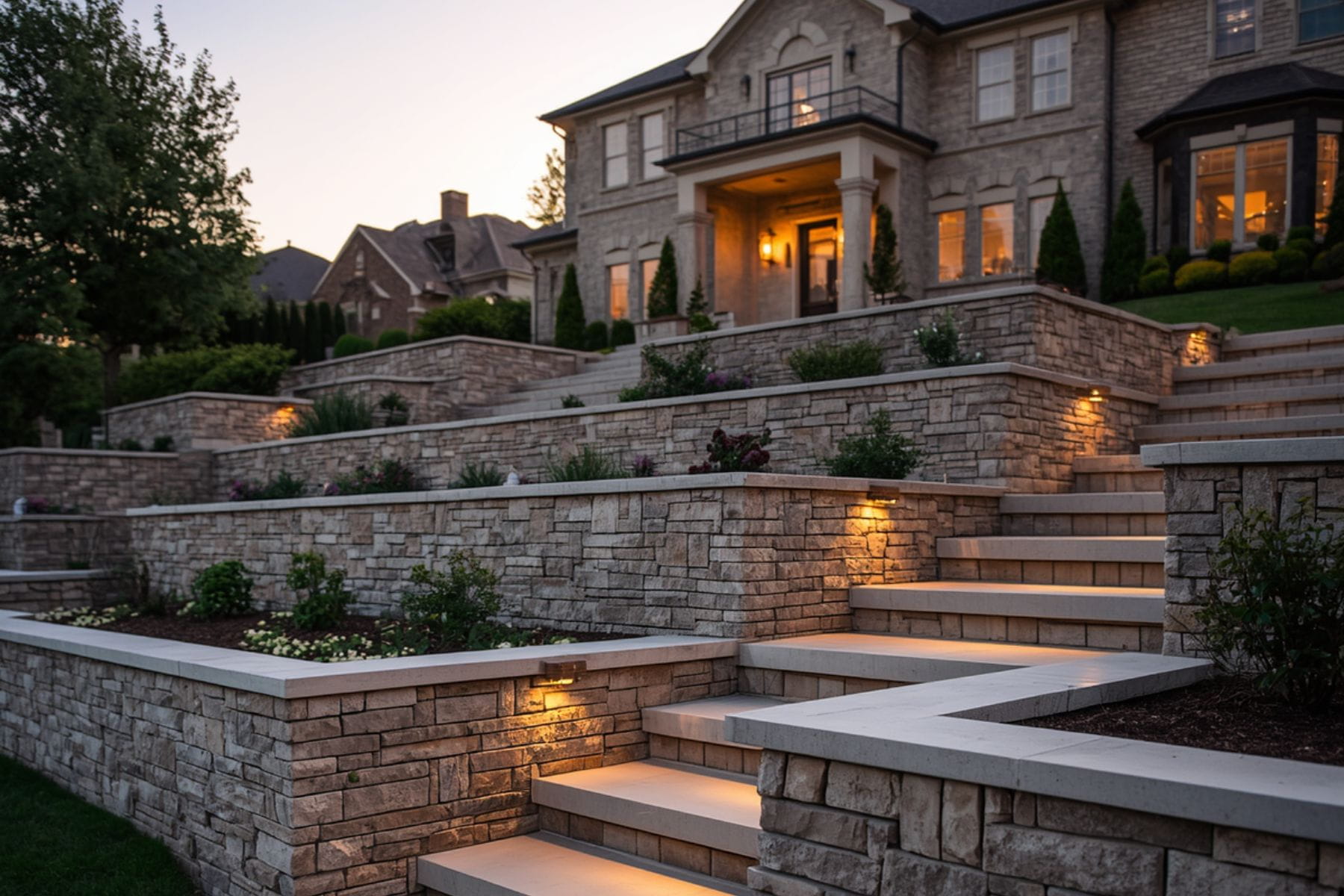
Staten Island Retaining Walls
Built to Hold — Every Wall Designed, Built, and Backed by Our Own Crew
Island Built Masonry designs and builds retaining walls throughout Staten Island. We handle every project in-house — no subcontractors, no handoffs. Whether you need a low garden wall to define a planting bed or a full-depth structural wall to stabilize a grade change, we deliver the engineering and craftsmanship the job requires.
Staten Island Retaining Wall Contractors
A retaining wall does real structural work. It holds back thousands of pounds of soil, manages water pressure, and must flex through years of Staten Island freeze-thaw cycles without failing. This is not work to assign to whoever is available — it requires experienced masons who understand drainage, footing depth, and the compressive and lateral loads involved.
Every wall Island Built Masonry builds is planned by our team, built by our team, and inspected by our team before we consider a project complete. Homeowners in Tottenville, Annadale, New Dorp, and Great Kills know that when the Island Built Masonry crew arrives, it is the same people who gave them the estimate — not a subcontractor they have never met.
Retaining Wall Types and Installation
We install retaining walls in several materials depending on the application, aesthetic preference, and site conditions.
Concrete Block Retaining Walls
Segmental retaining wall block — brands like Allan Block, Versa-Lok, and Anchor Diamond — is the most common choice for residential retaining walls in Staten Island. It is engineered for lateral load performance, installs cleanly, and handles freeze-thaw movement well when properly installed with a battered (back-leaning) face and compacted backfill.
We install block walls up to the height limits that do not require engineering stamp, and work with licensed engineers for taller applications that fall under NYC DOB review.
Natural Stone Retaining Walls
Bluestone, fieldstone, and granite outcropping walls are a natural fit for Staten Island properties with traditional architecture. We dry-stack or mortar-set natural stone walls depending on height, drainage conditions, and homeowner preference. Dry-stack walls allow water to weep through naturally; mortared walls require dedicated drainage infrastructure behind them.
Poured Concrete Retaining Walls
For structural applications — high walls, heavy surcharge loads, proximity to structures — a poured concrete wall is often the correct specification. We form, reinforce, and pour concrete walls engineered for the specific load condition. This is the solution for steep hillside lots and applications where failure is not an option.
Brick Retaining Walls
Brick retaining walls are a period-appropriate choice for homes in St. George, Stapleton, and other older Staten Island neighborhoods. We build brick walls with proper weep holes, reinforcement, and footing depth for NYC climate conditions.
Our Retaining Wall Construction Process
Step 1 — Site Assessment and Design We evaluate the grade change, soil type, drainage patterns, and surcharge conditions (weight above the wall — structures, driveways, foot traffic). The wall is designed before the first shovel breaks ground.
Step 2 — Permits Many retaining walls in New York City require a permit from the Department of Buildings, particularly walls over 4 feet or walls near property lines. We handle permit applications and coordinate with DOB inspectors as required.
Step 3 — Excavation and Footing We excavate to the required depth — typically below the frost line for Staten Island, which means a minimum of 36 to 42 inches below grade for the footing course. A properly deep footing is what separates a wall that lasts from one that leans within a few winters.
Step 4 — Drainage System Installation Drainage behind a retaining wall is non-negotiable. We install a perforated drain pipe at the base of the wall, surrounded by clean crushed stone, which channels water away from the wall and prevents hydrostatic pressure buildup. This step is what most failed DIY walls and cheap contractors skip.
Step 5 — Wall Construction Wall material is set course by course, with proper batter, tie-backs or deadmen where required, and compacted backfill placed in lifts. Capstone or coping is set at the top to finish the wall cleanly and protect the top course.
Step 6 — Grading and Cleanup Final grading, topsoil placement, and site cleanup. We leave the property in better condition than we found it.
When Do You Need a Retaining Wall?
Soil erosion on a sloped yard — If rain events are washing soil downhill or creating bare spots, a retaining wall stabilizes the grade and ends the erosion cycle.
Grade change near a structure — When a slope runs toward a house foundation, garage, or driveway, a retaining wall redirects soil pressure and water away from the structure.
Creating usable flat yard space — A retaining wall allows you to cut into a slope and create a level patio, lawn area, or garden bed. Common in Staten Island’s hillier neighborhoods — Annadale, Huguenot, and Eltingville all have significant grade variation.
Driveway or walkway protection — Walls alongside driveways prevent soil from encroaching onto the surface over time and protect against slumping during wet seasons.
Aging wall replacement — Many Staten Island properties have retaining walls built decades ago that are leaning, cracking, or failing. We assess whether repair is viable or whether full replacement is the right call.
Retaining Wall Service Area — Staten Island
Island Built Masonry serves all of Staten Island. We build retaining walls in every neighborhood including:
- Great Kills and Eltingville
- Tottenville and Huguenot
- Annadale and New Dorp
- St. George and Stapleton
- All surrounding communities
We are based on Staten Island. We know the soil conditions, drainage patterns, and DOB requirements for this borough specifically.
Frequently Asked Questions — Retaining Walls Staten Island
Do retaining walls require a permit in Staten Island? Yes, in most cases. New York City Department of Buildings requires permits for retaining walls over 4 feet in height, walls near property lines, and walls that support surcharge loads such as driveways or structures. Island Built Masonry handles permit filing and DOB coordination for all applicable projects. We do not ask homeowners to navigate the permit process alone.
How long do retaining walls last? A properly built retaining wall with correct drainage, adequate footing depth, and quality materials should last 25 to 50 years in Staten Island conditions. Walls that fail early almost always have a drainage problem — water builds up behind the wall and the pressure eventually wins. Our drainage system installation is mandatory on every project.
Do you use subcontractors for retaining wall work? No. Island Built Masonry does not subcontract any portion of a retaining wall project. Our in-house crew handles every phase — excavation, drainage, wall construction, and finish grading. You know who is on your property.
What causes retaining walls to fail? The most common failure mode is hydrostatic pressure — water saturating the soil behind the wall with no path to escape. This is a drainage design failure, not a material failure. The second most common cause is inadequate footing depth: walls with footings above the frost line get pushed by freeze-thaw cycles every winter until they lean or collapse. We build walls that address both failure modes from the start.
Can you repair my existing retaining wall instead of replacing it? Sometimes. We assess each wall honestly — if the drainage system can be improved and the existing wall structure is sound, repair may be viable. If the wall is leaning significantly, the footing has heaved, or the material has deteriorated beyond repair, replacement is the right answer. We will tell you which applies to your wall and explain our reasoning.
Get a Free Estimate for Your Retaining Wall
Island Built Masonry provides free on-site estimates for retaining wall projects across Staten Island. We will assess your site conditions, discuss your options, and give you a written estimate with a clear scope of work.
No subcontractors. No shortcuts. Request a Quote today.