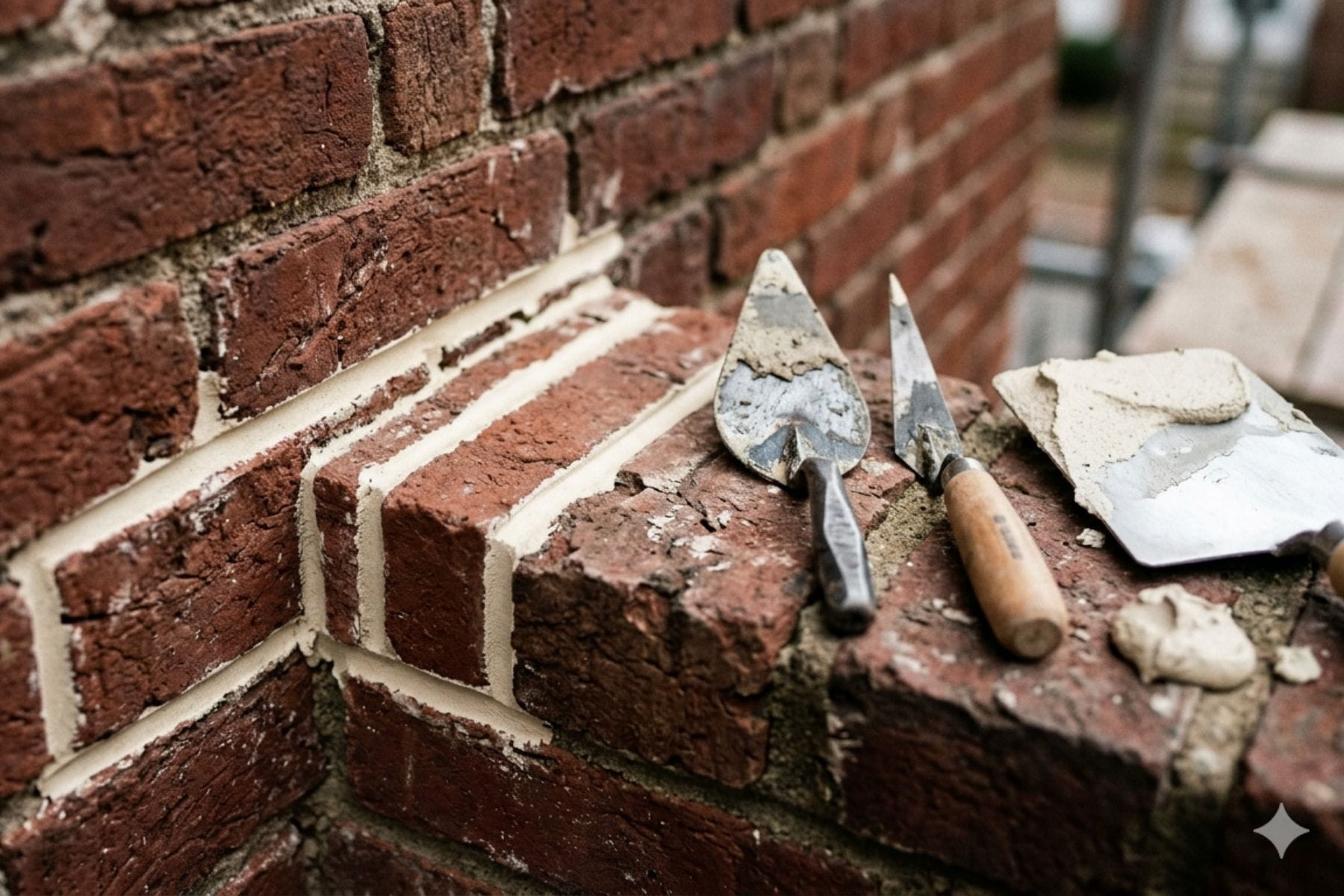
Staten Island Tuckpointing
Licensed masonry contractors serving Great Kills, Tottenville, Annadale, New Dorp, Eltingville, St. George, Stapleton, Huguenot, and all of Staten Island — no subcontractors, ever.
Tuckpointing is one of the most important maintenance services a Staten Island homeowner or property manager can invest in. When mortar joints fail, the brick or stone they hold together is no longer waterproof. Every rainstorm, every snowmelt, every freeze-thaw cycle drives water deeper into the wall assembly. Island Built Masonry specializes in tuckpointing and repointing that stops that process and extends the life of your masonry by decades.
We are a fully licensed masonry contractor. Every mason on your project is an Island Built Masonry employee — not a subcontractor hired job by job with no stake in quality. Our no-subcontractor policy is how we maintain standards and stand behind our work.
Request a Free Estimate — no pressure, no obligation.
What Is Tuckpointing?
Tuckpointing (sometimes called repointing or pointing) is the process of removing deteriorated mortar from the joints between brick or stone and replacing it with fresh, properly mixed mortar. The term originates from a traditional technique of using two contrasting mortar colors to create the visual impression of very fine joints — a detail still used on restoration work today. In common usage on Staten Island, tuckpointing and repointing are used interchangeably and refer to the same repair process.
The work looks simple but requires real skill. Mortar joints must be raked to a consistent depth — typically 3/4 inch — without damaging the surrounding masonry units. The new mortar must be selected to match the original in hardness, composition, and porosity. The joint profile must match the surrounding masonry for both appearance and water-shedding performance. Done correctly, the repair is invisible and lasts 25 to 40 years. Done incorrectly, it traps moisture, accelerates spalling, and needs to be redone in five years.
Why Tuckpointing Matters for Staten Island Masonry
Staten Island occupies a uniquely punishing climate zone for masonry. The borough sits at the edge of New York Harbor, exposed to moisture from the surrounding waterways and the full force of northeastern winter weather. Mortar joints that appear sound in summer reveal their failure modes through winter: water enters, freezes, expands, and fractures the surrounding joint. Each freeze-thaw cycle widens the gap.
The result is a progressive, self-accelerating problem:
- Mortar erodes and cracks develop
- Water infiltrates during rain and snowmelt
- Freeze-thaw cycles expand the cracks
- Brick faces begin to spall as moisture migrates into the brick body
- Water now enters the wall assembly, damaging insulation, framing, and interior finishes
Tuckpointing at Step 1 or 2 costs a fraction of what it costs to address the problem at Step 4 or 5. This is not a scare tactic — it is the predictable physics of water and masonry in a northeastern climate.
Why Mortar Joint Quality Matters
Not all mortar is the same, and this is where inexperienced contractors cause real damage.
Modern high-strength Portland cement mortars are harder than the brick used in most pre-1960 construction. When you point a 1940s brick wall with Type S or Type N Portland mortar that is harder than the brick itself, you trap moisture inside the brick with no release path. The brick absorbs the stress instead of the mortar — and brick spalling follows. The mortar looks fine; the brick is being destroyed.
Experienced masons specify mortar by ASTM type and sand composition, matching the compressive strength and porosity of the existing masonry. On older homes in St. George, Stapleton, or Tottenville — where soft common brick from the pre-war era is the rule — this matching process is critical. Island Built Masonry assesses the existing masonry before specifying mortar. This is the professional standard that most competitors skip because it takes longer and requires more expertise.
Our Tuckpointing Process
1. Inspection and Assessment
We begin every tuckpointing project with a thorough inspection of the wall surface. We identify all areas of joint deterioration, assess the brick or stone for existing damage, and note any moisture staining or spalling that indicates active water intrusion. This gives us a complete picture of the scope before we quote.
2. Joint Preparation
Deteriorated mortar is removed using angle grinders, rotary tools, or hand chisels depending on joint size and the sensitivity of the surrounding masonry. Joints are opened to a minimum depth of 3/4 inch to ensure the new mortar has adequate bond depth. All dust and debris are cleared.
3. Mortar Selection and Mixing
We select mortar type based on the age and composition of the existing masonry. For modern brick construction, we typically use Type S or Type N depending on exposure. For older or softer masonry, we move to a lime-based or Type O mix. Mortar color is blended to match the existing joints as closely as possible.
4. Packing and Tooling
New mortar is packed into the prepared joints in lifts, allowing each layer to begin setting before the next is added. The joint face is then tooled to match the profile of the surrounding work — concave, weathered, flush, or other as appropriate. Consistent tooling is what makes a tuckpointing job disappear into the existing wall.
5. Cleanup and Waterproofing
After the mortar has cured, we clean the wall face and, where specified, apply a penetrating masonry waterproofer to seal the entire surface from further water infiltration.
Signs You Need Tuckpointing
Many homeowners discover they need tuckpointing after water damage has already begun. Here are the warning signs to catch it early:
- Mortar crumbling or falling out — If you can press mortar out of a joint with your finger, it has lost its bond and is no longer providing protection
- Visible cracks in joints — Hairline cracks visible from the ground are wider than they look and actively admitting water
- White staining (efflorescence) — White mineral deposits on the brick face indicate water is moving through the wall and depositing minerals as it evaporates
- Damp or stained interior walls — Water following masonry joints into your wall cavity will eventually show up on interior surfaces
- Brick spalling — Flaking or popping brick faces are downstream of mortar failure; tuckpointing is still the first repair step
- Wall age — Most mortar has a useful life of 25 to 50 years depending on exposure. Homes built before 1990 on Staten Island are typically approaching or past first repointing time
Tuckpointing Company Serving All of Staten Island
Island Built Masonry performs tuckpointing and repointing throughout Staten Island, including:
- Great Kills — Large mid-century residential neighborhoods with brick homes now at or past first repointing time
- Tottenville — Historic and Victorian-era masonry with soft brick requiring careful mortar specification
- Annadale — Suburban residential development; we see regular tuckpointing volume as 1970s–1980s homes age
- New Dorp — Active service area for tuckpointing; NYC winters consistently drive spring demand here
- Eltingville — Residential neighborhoods with a mix of brick and stone masonry requiring repointing
- St. George — Older urban brick construction; this neighborhood has some of Staten Island’s most historically significant masonry that deserves careful restoration
- Stapleton — Waterfront location increases salt and moisture exposure; more aggressive repointing schedules recommended
- Huguenot — Southern Staten Island residential; full tuckpointing services available
We also serve Westerleigh, Dongan Hills, Bay Terrace, Bulls Head, Oakwood, Richmond Valley, Charleston, and all surrounding Staten Island neighborhoods.
Frequently Asked Questions — Tuckpointing
How often should masonry joints be repointed? Mortar life depends on exposure, original mix quality, and climate. On Staten Island, with the combination of NYC winters and coastal moisture, a well-built joint typically lasts 25 to 40 years. Heavily exposed walls — north-facing, close to the waterline, or subject to splash from gutters — may need attention sooner. Have your masonry inspected if the structure is 20 or more years old and has never been repointed.
Can tuckpointing prevent water damage to my interior? Yes — tuckpointing is one of the most effective preventive measures you can take for a masonry structure. Failed mortar joints are among the most common paths for water to enter a building envelope. Repointing stops water at the wall surface rather than allowing it to migrate into the structural assembly, insulation, or interior finishes.
What is the difference between tuckpointing and repointing? Technically, tuckpointing refers to a decorative technique using two mortar colors to simulate fine joints, while repointing simply means replacing deteriorated mortar. In everyday use throughout Staten Island and the New York metro area, the terms are used interchangeably to mean mortar joint repair and replacement. When you call us about tuckpointing, we know exactly what you need.
Will the new mortar match my existing brickwork? We blend mortar color to match your existing joints as closely as possible. An exact match is difficult because the original mortar has aged and weathered, but our color blending process produces results that are typically indistinguishable from a few feet away. Over time, as the new mortar weathers, the match improves further.
Is tuckpointing a job for areas of my wall or the whole surface? Both approaches are used. Spot tuckpointing addresses specific areas of deterioration — often the right call when most of the wall is sound. Full repointing replaces all joints on a surface and is appropriate when deterioration is widespread. We assess which approach makes economic and technical sense for your specific wall and give you a clear recommendation.
Request a Free Tuckpointing Estimate
Island Built Masonry brings licensed expertise, proper mortar specification, and our commitment to self-performed work to every tuckpointing project on Staten Island. We do not cut corners on mortar selection, and we do not subcontract your job to someone who will.
Call us or submit our contact form to schedule a free estimate. We inspect the work, explain exactly what needs to be done, and give you a written quote — no surprises.
Protect your masonry before NYC winters do further damage. Island Built Masonry — Staten Island tuckpointing done right, by a crew that stands behind it.